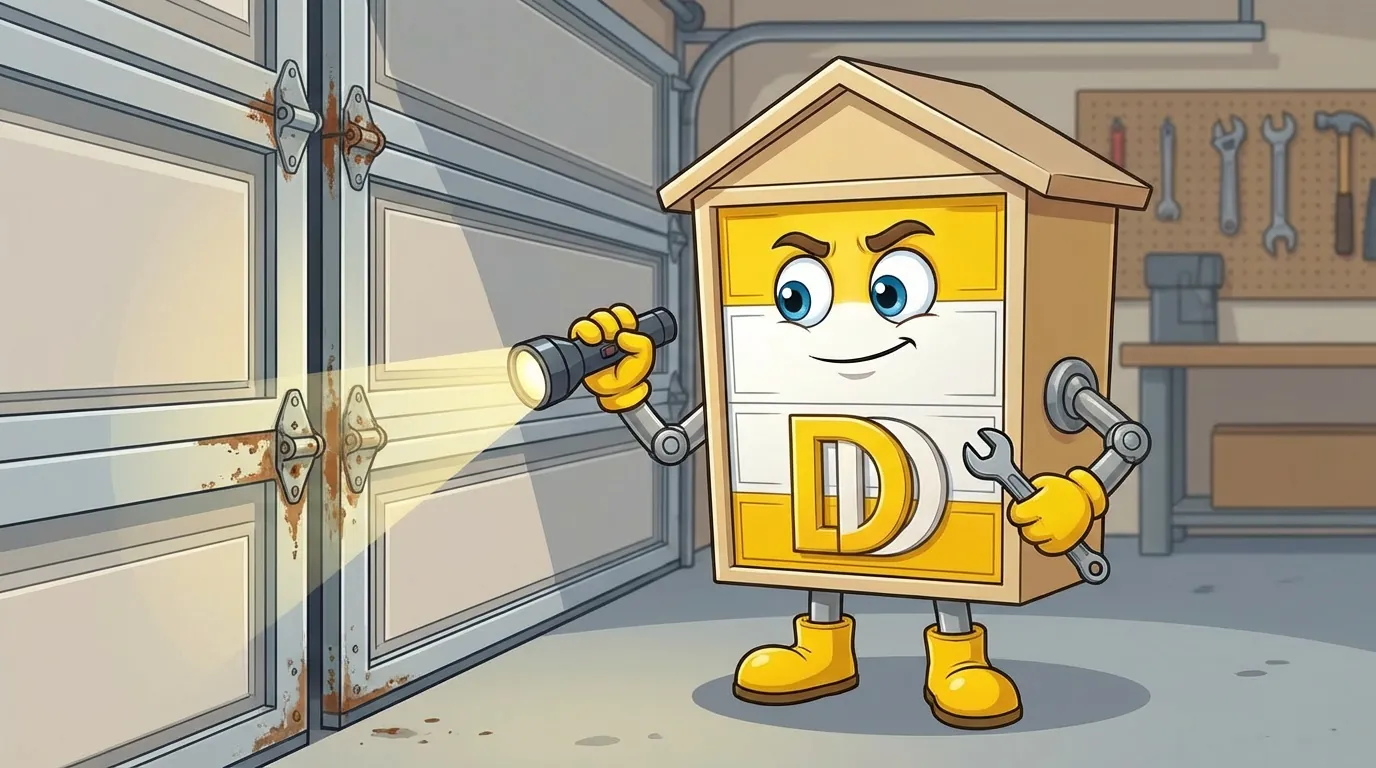
Hinges are the quietest failure point on a garage door. They do not scream like worn rollers. They do not pop like a snapped spring. They wear gradually, then crack quickly, and by the time you notice, a panel is already damaged.
The good news: hinge inspection takes 10 minutes, a single hinge replacement is a $15 part, and most Mission homeowners can do both themselves with basic tools.
This guide covers:
- What hinges actually do on a sectional garage door
- The 5 signs of a hinge that needs replacement
- Which hinges fail first (hint: not the ones you think)
- DIY replacement step by step
- When to replace the entire set vs. one at a time
Hinge Basics: What They Actually Do
A sectional garage door is made of 4 or 5 horizontal panels stacked on top of each other. Hinges connect each panel to the one above and below, allowing the panels to flex as the door transitions from vertical (closed) to horizontal (open).
Two types of hinges:
- Centre hinges run across the middle of each panel joint, typically 2 per joint on a single-car door and 3 per joint on a double-car door
- End hinges (also called “brackets”) sit at each end of each panel joint and hold the rollers
Standard residential door: 8 to 12 centre hinges plus 4 to 8 end hinges (which double as roller brackets), depending on door width.
Each hinge is stamped steel with a small pivot pin riding in a metal-on-metal bushing. Over 10,000 to 20,000 cycles, that pin slowly wears the bushing oversize, the hinge develops play, and eventually either the pin shears or the hinge body cracks.
The 5 Signs of a Failing Hinge
Do this walk-around while the door is closed, inside the garage, with the opener disconnected.
1. Visible cracks in the hinge body
Look at each hinge body where it bolts to the door panel. You are looking for:
- Hairline cracks radiating from the bolt holes (often the first sign)
- Larger visible cracks on the hinge knuckle (the folded edge)
- Rust staining where a crack has been leaking moisture
Any crack = immediate replacement. A cracked hinge can fail mid-cycle and slam a panel corner into the track.
2. Orange rust on the pivot pin
Look at the pivot pin of each hinge. A healthy pin is smooth and shows the original finish.
- Orange staining on the pin means the hinge has been running dry for a while
- Rust ring around the pin where it meets the hinge body is more advanced wear
- Pin is visibly discoloured or rough = lubricate now, replace in 6 months if it happens again
This is the earliest warning sign and often catches a hinge 6 to 12 months before actual failure.
3. Visible play when you wiggle a panel
Stand in front of the door (still closed). Grab the edge of one panel and wiggle it gently up and down.
- No movement = hinges are tight, everything is fine
- Slight wiggle, maybe 1-2mm = normal wear, lubricate and re-inspect next year
- Noticeable wiggle, 5mm+ = hinges are worn, plan replacement
- Loose, sloppy movement or clunking = replace immediately
The panel that wiggles is the one whose hinges are weakest. Replace the hinges on BOTH sides of that panel joint, not just one side.
4. Elongated hinge pin holes
Pull the door partway open with the opener disconnected. Get eye-level with a middle hinge.
- Pin hole is round and tight around the pin = healthy
- Pin hole looks slightly oval, like an egg = wear is advanced
- Visible gap between pin and hole = replace immediately
This inspection is the most accurate single diagnostic. A properly running hinge has zero visible gap at the pin.
5. Grinding or knocking during operation
With the door closed and opener reconnected, operate the door and listen carefully to each panel joint. A knocking sound that syncs with the door’s travel speed is almost always a hinge on that specific joint.
If you cannot localize it by ear, have a second person run the door while you stand near each joint and feel for vibration.
Which Hinges Fail First
Not every hinge wears at the same rate. On a typical Mission residential door:
| Hinge position | Wear rate | Why |
|---|---|---|
| Bottom corner (end hinges) | Fastest | Carry the roller weight + spring tension transfer |
| Top corner (end hinges) | Fast | Pivot angle is steepest when transitioning vertical/horizontal |
| Middle centre hinges (single row) | Moderate | Flex load during travel |
| Middle end hinges | Moderate-slow | Roller load but lighter flex |
| Top row centre hinges | Slowest | Minimal flex when door is open and hanging flat |
Practical implication: if you are replacing one hinge, you are almost certainly going to replace more within 12 months. Consider replacing all the hinges on the bottom panel joint at once, then monitoring the rest.
DIY Hinge Replacement
Per hinge: 10-15 minutes, $10 to $20 in parts, basic tools.
What you need
- Adjustable wrench or 7/16” socket wrench
- Work gloves
- Replacement hinges (match the size and gauge of your existing - take one to the hardware store)
- Silicone lubricant for the new pin
Important: hinge “size” refers to the thickness of the panel it is designed for. #1 hinges are for thin panels (1 3/8 inch), #2 for standard (1 3/4 inch), #3 for thick insulated (2 inch). Match the size or the door will not align properly.
The replacement steps
- Close the door fully and disconnect the opener (pull red release cord)
- Locate the failing hinge and identify the four bolts holding it to the two panels
- Start with the bolts on the UPPER panel - loosen but do not remove
- Remove the bolts on the LOWER panel - the hinge will hinge down away from the panel
- Now remove the remaining upper-panel bolts and take the hinge off
- Test-fit the new hinge against the existing bolt holes (should line up)
- Attach to the UPPER panel first - two bolts, hand-tight
- Swing the hinge into position against the lower panel and attach those two bolts
- Tighten all four bolts progressively (do not over-tighten - steel panels strip easily)
- Lubricate the new pin with a light spray of silicone
- Repeat for any other hinges being replaced
- Reconnect the opener and run two full cycles listening for new sounds
Heads up: if the existing bolt holes are elongated from wear, the new hinge will not sit flush. In that case, you need to reposition the hinge slightly and drill new holes, or replace the panel. That is a technician call.
When to Replace the Whole Set
One hinge at a time is fine for early-stage wear. Replace all hinges at once if:
- Three or more hinges show signs of wear during inspection
- Door is 20+ years old and has never had hinge service
- Hinges are all the same era (original to the door) and one is failing
- You are doing a major service visit anyway (spring replacement, door re-balance)
A full hinge replacement on a standard residential door runs 2 to 3 hours and $250 to $400 installed (parts and labour). DIY parts-only is $100 to $180.
Mission Specifics
Long damp winters
Mission’s climate is wet. Long sustained rain in the fall and winter, sometimes into April. Hinges suffer more than in drier parts of the Lower Mainland because moisture works into the pin/bushing gap and accelerates wear.
The fix: annual silicone spray on every hinge pin, timed to late April or early May after the rain ends. This is the single cheapest way to extend hinge life in Mission.
Older housing stock
A lot of Mission homes were built in the 1970s and 1980s with original garage doors that are still in service. Hinges from that era are often the lighter #1 or #2 gauge, which wear faster than modern #3 hinges on insulated doors.
If your door is original and the hinges look thin, an upgrade to heavier-gauge hinges during replacement adds maybe $30 to the job and can double the lifespan.
Rural routes and distance to parts
Mission’s rural and semi-rural areas are further from major parts suppliers. If you are planning a hinge job, order the parts online (Amazon has all the standard sizes) rather than making multiple runs to Home Depot.
When to Call a Technician
- Hinge bolt holes in the door panel are stripped or elongated
- More than 3 hinges need replacement simultaneously
- You find a crack in the hinge that has already caused panel damage
- The door is an original pre-1985 build and you are not sure what parts fit
- You would rather pay $300 and have it done in 2 hours
We handle garage door maintenance and full hinge service across Mission and the rest of the Fraser Valley.
Bottom Line
Hinges are the quietest failure on your garage door. They wear gradually, then crack quickly, and they take out a panel on the way down if ignored. A 10-minute annual inspection catches 95% of problems before they turn expensive.
Your hinge maintenance plan:
- Annual visual inspection (5 signs: cracks, rust, wiggle, elongated holes, noise)
- Annual lubrication pass (silicone spray on every pin)
- Replace individual hinges as they show wear
- Full set replacement on doors 20+ years old or showing multiple failures
- For any cracked hinge: stop using the door until it is replaced
If you want a professional inspection, book a maintenance visit - we include a full hinge check in every standard service call.