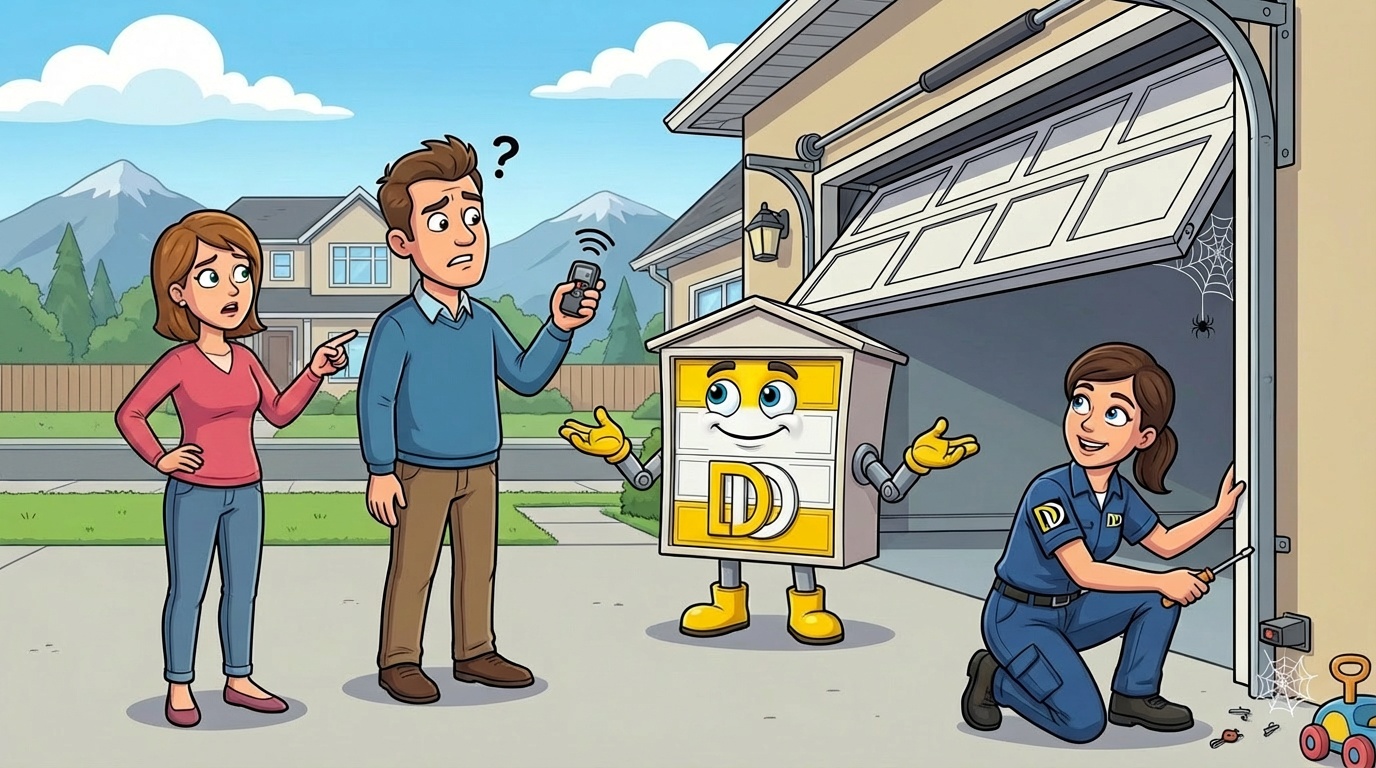
A garage door that opens by itself is unnerving. It’s also a real problem — not a ghost, not interference from a UFO, and not something you should ignore, because while the cause is almost always mundane, the consequence is always the same: your garage is sometimes unlocked when you think it’s locked. For Port Moody homeowners who’ve been woken up at 3 AM to find the garage open for no reason, this is the post that explains what’s happening and how to fix it.
There are six common causes of “ghost operation,” ranked by how often we find each one during service calls. Work through them in order and you’ll usually identify the culprit in under an hour.
What “Opens by Itself” Actually Means
Before troubleshooting, clarify the symptom. “Opens by itself” can mean several different things, each with different causes:
- Partial open: The door cracks open a few inches but doesn’t fully open.
- Full open cycle: The door goes all the way up as if someone pressed the button.
- Opens repeatedly: The door opens multiple times across a day with no obvious trigger.
- Opens at specific times: The door opens on a consistent schedule, like every morning or every Sunday afternoon.
These clues actually matter. Partial opens usually point to mechanical issues. Full open cycles point to electrical or signal issues. Scheduled opens point to timers or interference from nearby signals.
1. A Stuck Wall Button (The Most Common)
The wall-mounted button inside your garage is the single most common cause of ghost operation. The button itself can:
- Have dirt or debris lodged behind the switch mechanism
- Have a stuck contact that’s partially completing the circuit
- Have a damaged wire behind the button that intermittently shorts out
When any of these happens, the opener gets a legitimate “open” command and obediently opens the door. You didn’t press it, but it thinks you did.
How to check: Unplug the opener. Remove the wall button cover. Check the two wires for signs of damage, discoloration, or insects. Press the button manually several times — it should feel like a clean, positive click, not mushy or sticky.
Fix: Clean the button contacts, replace the wall button unit ($15–$25), or replace the wiring from the button to the opener. This is DIY-friendly for most homeowners.
2. A Faulty Remote with a Stuck Button
Remote controls wedged in a drawer, couch cushion, or car centre console can press their own buttons. The remote keeps transmitting as long as the button is held down. If it’s within range of your opener — and most modern remotes reach 50+ metres with clear line of sight — it’ll open your door every time it transmits.
How to check: Do you have extra remotes you don’t use regularly? Where are they? In a drawer with other objects? In a glovebox? In a desk? Collect all of them.
Fix: Check each remote for stuck buttons. If one is triggering, clean it, replace the battery, or retire it. If you don’t know which remote is causing the problem, the fastest test is to remove the batteries from every remote and see if the ghost operation stops.
If you have an old remote you no longer use, remove its programming from the opener entirely. Most openers have a “erase all remotes” button that resets the paired remotes list.
3. A Neighbour with an Old Fixed-Code Opener
This one is much less common now but still happens in Port Moody’s older neighbourhoods. Openers manufactured before 2011 often used fixed codes — a specific signal that never changed. If a neighbour has an opener with the same fixed code as yours, their remote will open your door too.
How to check: Is your opener more than 15 years old? Does the ghost operation correlate with specific times (like when a neighbour comes home from work)?
Fix: Upgrade to a modern opener with rolling codes. Rolling-code openers change their signal every time they’re used, making duplicate-code conflicts essentially impossible. We handle garage door opener replacement and upgrades regularly for this exact reason. A modern belt-drive opener installed is $550–$900, and the rolling code gives you both security and reliability.
4. Electrical Interference or Power Surges
Garage door openers can be triggered by electromagnetic interference — surges from nearby high-power equipment, faulty transformers, or induction from long wires running parallel to the opener’s low-voltage circuit. This is uncommon but real.
How to check: Does the ghost operation correlate with specific events (starting a clothes dryer, welding, thunderstorms, electrical work)? Do you live near commercial equipment, radio antennas, or power substations?
Fix: Install a surge protector on the opener’s power circuit. If the issue is coming from long antenna wires picking up interference, shortening or shielding them can help. In severe cases, relocating the opener’s power circuit to a different breaker may be needed. This is a technician call — we’d troubleshoot as part of garage door repair.
5. A Failing Logic Board
Inside every modern opener is a small circuit board that interprets button presses, manages the motor, and runs safety systems. As these boards age — especially the ones in openers 10+ years old — they can develop faults that cause random outputs. A failing capacitor, for instance, can send a false trigger to the motor at unpredictable intervals.
How to check: Is your opener more than 10 years old? Are the ghost opens random in timing with no obvious correlation to wall buttons or remotes? Does the opener occasionally do other strange things (light flickering, random motor buzz, inconsistent operation)?
Fix: Logic board replacement on older openers is usually more expensive than buying a new opener. If your unit is 10+ years old and having intermittent issues, replacement is the right call.
6. A Neighbour Using a Smart Home Integration Incorrectly
More modern and increasingly common: a family member installed a smart home automation (Apple HomeKit, Google Home, or a third-party hub) that’s configured to open the garage under certain conditions, and that automation is firing when nobody expected it.
How to check: Who in the household has access to the smart home system? What automations are configured? Is there a geofence (“open garage when my phone is within 500m”) that could be triggering?
Fix: Audit your smart home automations. Remove, disable, or tighten any that control the garage door. This is the fastest-growing cause of ghost operation calls we receive, and it’s 100% resolvable by someone who knows the app.
Diagnostic Reference
| Symptom | Most likely cause | DIY? |
|---|---|---|
| Opens repeatedly, random times | Stuck wall button | Yes |
| Opens when family is away | Stuck remote or smart automation | Yes |
| Opens around neighbour’s return home | Old fixed-code opener | Opener replacement |
| Opens during thunderstorms | Electrical interference | Technician |
| Opens with other weird behaviour | Failing logic board | Opener replacement |
| Opens at the exact same time each day | Smart home automation | Yes (app fix) |
What to Do Right Now
If your door is actively opening on its own and you don’t know why, take these immediate steps:
- Unplug the opener. This stops ghost operation immediately.
- Lock the door manually if it has a manual lock, or at minimum engage the emergency release so the opener can’t move the door even if plugged back in.
- Collect all remotes and take out their batteries.
- Lock the interior door from the garage into the house.
Those four steps make you secure tonight. Troubleshooting can happen tomorrow.
When to Call a Professional
Most ghost operation resolves with the DIY steps in this post. Call for a service visit if:
- You’ve worked through every cause above and the problem persists
- Your opener is more than 10 years old and the issue is intermittent
- You suspect logic board or motor issues
- You want a full security audit of an opener that’s been behaving unpredictably
We handle garage door opener troubleshooting and replacement across Port Moody, Coquitlam, and the Tri-Cities area. Most ghost operation cases are diagnosed and fixed in a single visit.
Bottom Line
Garage doors don’t open by themselves. Something is triggering them — a stuck button, a forgotten remote, interference, or a failing component. The good news is that the cause is almost always identifiable and fixable. Run through the list in order, starting with the wall button and remotes, and you’ll find it. If the answer turns out to be a 15-year-old opener with a failing logic board, replacement is usually the right call anyway.
If you want it diagnosed professionally, book a service call and we’ll identify the cause and fix it on the same visit.