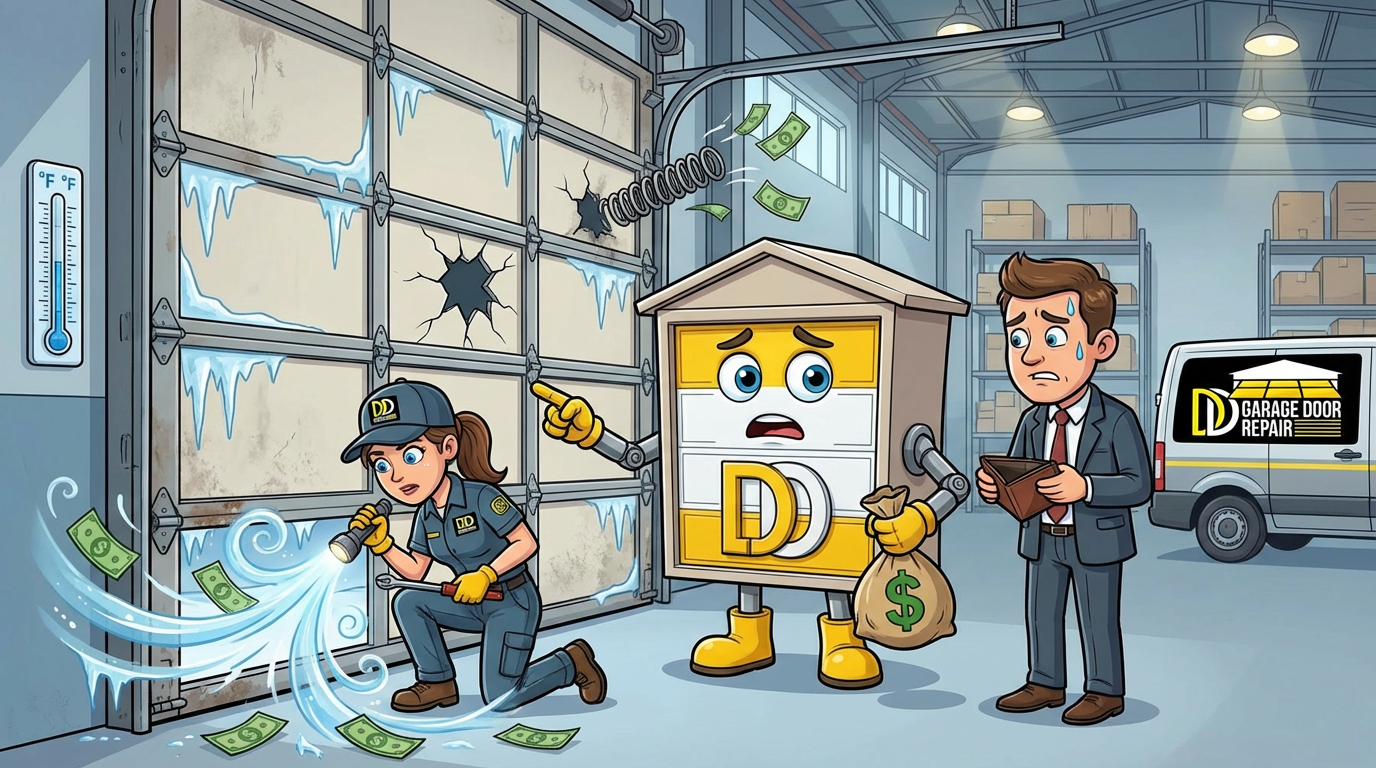
Commercial garage doors don’t usually fail dramatically. They degrade. A seal flattens, an insulation panel cracks, a weatherstrip peels — and for years nothing happens that makes you call a technician. But your utility bill is creeping up, your HVAC is working harder, and your staff is complaining that the warehouse is freezing in winter and sweltering in summer. None of this shows up on a repair invoice, so it’s invisible until someone actually looks for it.
If you run a business in Mission — especially in the Mission Industrial Park, along Lougheed Highway, or anywhere along the light-industrial corridor — these five signs are worth knowing about. Each one points to a specific problem, each one has a specific fix, and each one is costing you money right now.
Sign 1: You Can Feel a Draft Standing Near a Closed Door
Walk up to a closed commercial garage door on a windy day in January. Put your hand near the perimeter — the bottom, the sides, the top. If you can feel air movement, you have leaks. Big ones.
A typical commercial sectional door should seal tightly enough that even on a windy day you feel nothing more than the cold of the metal itself. Noticeable airflow means one or more of:
- The bottom astragal seal is compressed flat or split
- The vertical weatherstripping has pulled away from the jamb
- The top header seal is missing or damaged
- The panel joints have opened due to hinge wear
Cost of ignoring it: Air leakage at a commercial door can drive 15–25% of the heating or cooling load for the adjacent building zone. On a mid-sized Mission warehouse with a few loading doors, that can translate to hundreds of dollars per month in wasted utility spend during peak seasons.
Fix: Replace the perimeter seals. A full reseal on a standard commercial sectional door takes 1–2 hours and costs $200–$500 in parts and labour. Payback is usually under one heating season.
Sign 2: The Door Doesn’t Sit Flat on the Ground
Stand inside the building, close the door, and look at the bottom edge from the inside. Is it sitting flat and square against the concrete? Or is there light visible underneath, a gap at one corner, or a visible wave where the bottom panel meets the floor?
A door that doesn’t close flat indicates:
- A damaged or warped bottom panel (usually from a forklift strike or a vehicle impact)
- An uneven concrete slab or slab settling
- Worn rollers or track misalignment causing the door to sit crooked
- A stretched or stripped lift cable letting one side drop further than the other
Cost of ignoring it: A ¾-inch gap along the full width of a 12-foot commercial door equals about 108 square inches of open airflow. That’s the equivalent of leaving a small window permanently open. In a cold storage facility or a heated warehouse, that’s a constant refrigeration or heating loss, plus water and pest intrusion.
Fix: Depends on the root cause. Damaged bottom panels can sometimes be straightened, or need replacement. Cable adjustments are routine. Concrete issues may need a threshold seal to bridge the gap. Expect $300–$1,500 depending on what’s actually wrong.
Sign 3: The Door Panels Have Visible Cracks, Dents, or Missing Insulation
Commercial doors take more abuse than residential. Forklifts, dollies, pallet jacks, and the occasional reversing truck all leave marks. Minor dents are cosmetic. Cracks that go through the panel, missing insulation foam, or holes from prior damage are all functional problems.
Walk the inside of your doors once a year and look for:
- Cracks through the outer skin that expose the foam core
- Sections where the foam has compressed, crumbled, or detached
- Holes left by removed hardware or impacts never properly repaired
- Rust perforation at panel edges (especially near the floor)
Cost of ignoring it: Damaged panels lose their R-value and their structural rigidity. A door with a cracked insulation layer is functionally a non-insulated door, which roughly doubles heat loss through that section. In a large facility with multiple doors, a couple of damaged panels per door can add up to a substantial energy cost.
Fix: Single panel replacements run $400–$1,200 depending on door brand and specifications. Full door replacement is $3,500–$12,000. Patching damaged panels is a short-term option but rarely a good long-term answer on commercial doors.
Sign 4: The Opener or Door Is Visibly Slower Than It Used to Be
This one is subtle. Commercial openers are sized to move a specific door weight at a specific speed. If the door has gotten heavier (water-logged panels, worn springs losing assistance, accumulated dirt on rollers), the opener works harder and runs slower. That extra work burns electricity and shortens the opener’s life. It also means the door spends more time in the “partially open” state — which means more air exchange with the outside — on every single cycle.
Over the course of a busy day, a door that used to cycle in 12 seconds and now cycles in 18 seconds is losing an extra 50% of air exchange time on every open and close. Multiply that by 50, 100, or 200 cycles per day and the heating/cooling loss adds up fast.
How to check: Time one full up-and-down cycle on each of your commercial doors. Compare against the factory spec (usually 6–9 inches per second for sectional doors). Anything significantly slower than spec is a red flag.
Fix: Typically starts with a spring and cable inspection, lubrication, and roller check. If the door is genuinely too heavy, spring replacement is the usual answer. Average fix: $300–$800.
Sign 5: You Don’t Know the Last Time Anyone Serviced It
This isn’t a physical symptom — it’s a calendar symptom. If nobody at your facility can name the date of the last professional service on your commercial doors, you’re running on luck. Commercial doors have wear components (springs, cables, rollers, bearings, seals) that all degrade on a predictable schedule. Left alone, they fail. When they fail, they fail at the worst possible time.
Most Mission commercial facilities that haven’t had a service visit in 2+ years have at least one of the issues above, and usually two or three. The only way to catch them before they turn into emergency repairs — or into silent money leaks on your utility bill — is to have them inspected.
Cost of ignoring it: Unpredictable. Some facilities go 5 years without an issue and then have three doors fail in the same quarter. Others see a steady drip of minor repairs that add up. Either way, the total cost is higher than scheduled service would have been.
Fix: Schedule an annual or twice-yearly commercial maintenance visit. Cost is $400–$900 per door depending on size and complexity. That includes a full safety audit, seal inspection, balance test, opener diagnostics, lubrication, and a written report of any issues found.
The Bigger Picture: Hidden Commercial Energy Costs
It’s easy to think of a garage door as a door, but on a commercial property it’s one of the largest openings in the entire building envelope. A poorly sealed, poorly maintained commercial door can account for more heat loss than several square metres of wall area. In a building with three or four doors, that’s a significant share of your total envelope performance.
Industry audit data suggests that 10–20% of commercial building energy losses run through garage and loading doors on buildings older than 15 years. That’s real money, and most of it is recoverable with relatively inexpensive fixes.
Quick Self-Audit
Walk each of your commercial doors with this checklist:
| Check | Action if yes |
|---|---|
| Feel draft at closed door perimeter | Reseal (2 hours, $200–$500) |
| Light visible under closed door | Bottom seal or panel repair |
| Cracked, dented, or rusted panels | Panel repair or replacement |
| Door cycles slower than spec | Service call (spring/cable/roller inspection) |
| Last service > 2 years ago | Schedule full maintenance visit |
If you check even one of these, it’s worth a service visit. If you check three or more, it’s long overdue.
Bottom Line
Commercial garage doors are silent offenders on the utility bill. Nothing fails dramatically — they just slowly stop doing their job, and you pay for it every month on a bill that feels inevitable. A $500 seal replacement can pay for itself in one winter. A $900 maintenance visit can catch three problems before they become emergencies.
We service commercial garage doors across Mission, Abbotsford, and the Fraser Valley, from single-door shops to multi-door distribution warehouses. Contact us for a commercial assessment and we’ll walk your site, flag the issues, and give you a prioritized list of fixes. For existing facilities that need ongoing service, we also offer scheduled garage door maintenance plans. No hard sell, just a straight answer on what’s costing you money and what isn’t.